
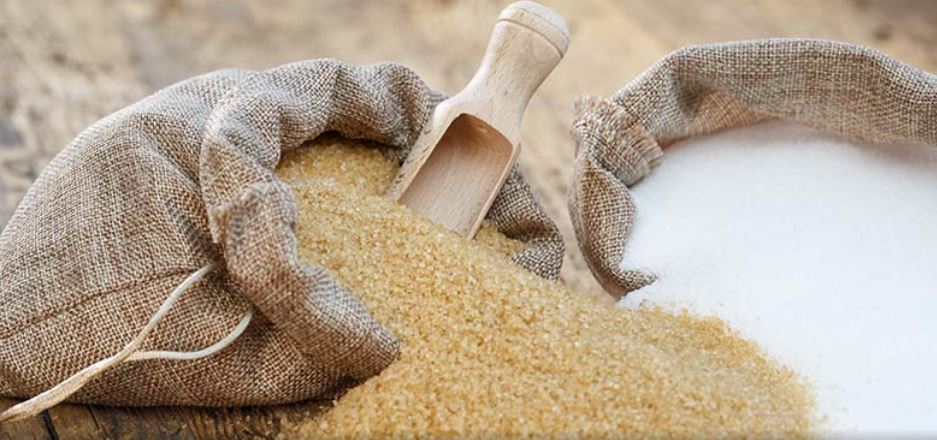
Everybody knows that sugar is the enemy in the tireless struggle toward healthy eating. But even the most health-conscious consumers can’t deny their instinctive love for sweets, which is why, given the option, you might reach for more healthy-looking sugars with packaging labelled with buzzwords like “raw,” “pure,” and “natural.” And while Sugar in the Raw is the most recognizable brand of turbinado on shelves, the exact same product is made by many other companies.
What you probably think of as “raw” sugar is actually a processed food that goes by the name turbinado sugar, and it’s distinct for its caramel color and larger crystal size. The chunkier size of the grains results from the length of the crystallization process, but the same sugar cane plant is used to produce white sugar, brown sugar, and “raw” sugar. Inside of each sugar cane stalk, you’ll find 30 teaspoons of sugar, 6 teaspoons of molasses, and 1 quart of water.
Now here’s where the biggest distinction lies. A coating of natural molasses is left around the grains of sugar after they crystalize (think dark brown sugar). In some cases, the majority of the molasses is left on. To create light brown sugar, more of the molasses is washed off. For white sugar, the crystals are washed until they are 99.5% sucrose, the purest form achievable.
No matter what type of sugar you’re using, it all comes from the sugar cane plant, one of the most sustainable crops in the world. Your body processes all forms of sugar cane in the exact same way. And when it comes down to it, the health benefits of the “micronutrients” preserved in the (trace amounts of) molasses don’t outweigh the sugar intake you consume from eating, well, sugar. If you are after the antioxidants, calcium, and magnesium said to be stored in blackstrap molasses, you’d need to opt for a jar of the real-deal, syrupy stuff itself, not crystalized baking sugars.
0 comments on “Here’s What You Didn’t Know About “Raw” Sugar” Add yours →